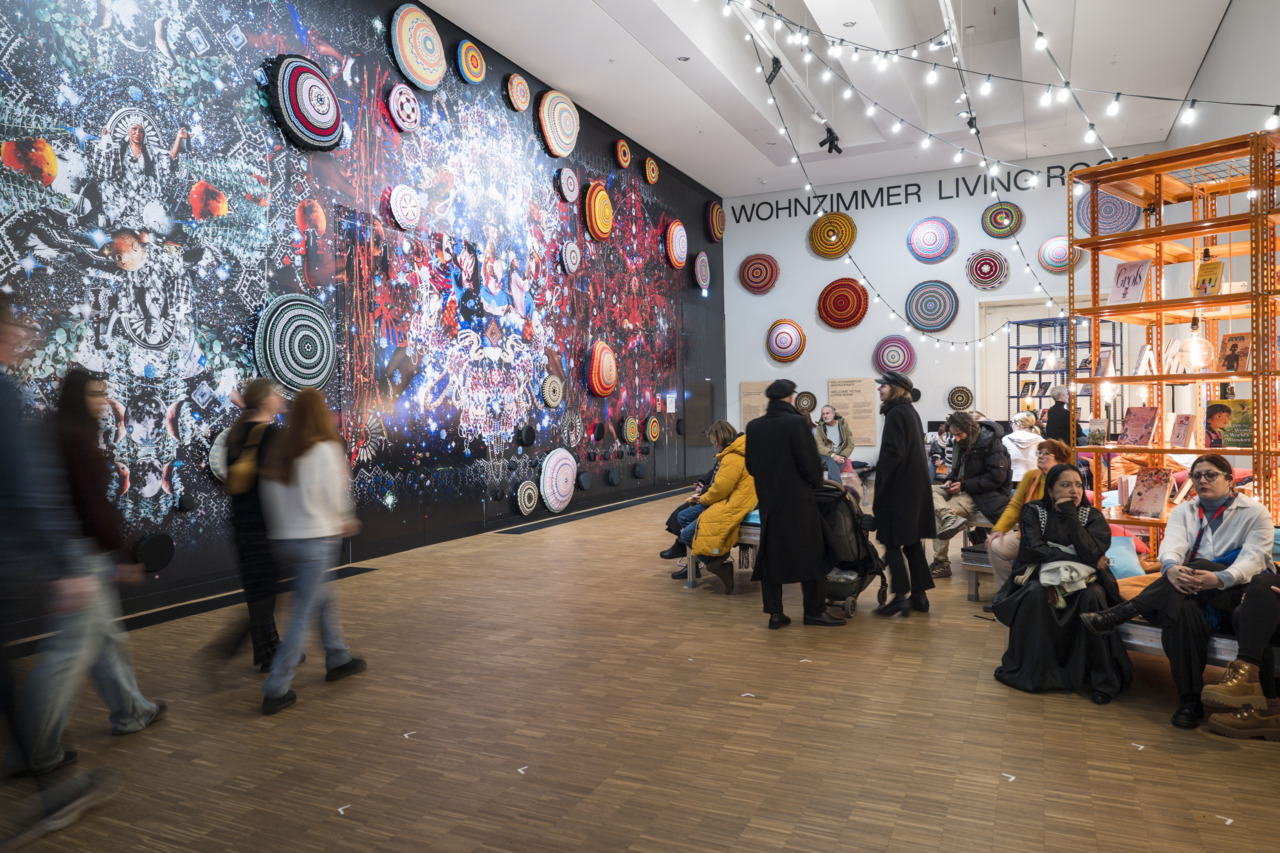
Living Room
Sat, 24 January – Sun, 12 July 2026
| free admission |
| Special exhibition foyer, ground floor |
| from 3 years |
| English, German |
| Opening hours Mon, Wed, Thu, Fri, Sat, Sun: 10:30 am – 6:30 pm Tue: closed |
Welcome to the Living Room. A gathering place of generations. This room invites you to read, relax, weave, knit, watch and listen. As part of the Family Matters programme, it offers the opportunity to unwind, become curious and actively explore.
The living room opens up access to diverse forms of family. It asks questions about how family backgrounds shape life paths and how one’s own life story is co-created or ‘woven’ together.
Collective wall collage and weaving and knitting workshop series
A participatory wall collage and workshop series explores the matriarchal lines of the Wayuu community through textile art and storytelling. Following the thread of The Story of Waleker, visitors are invited to weave along. Visit the workshop series The Gift of the Spider! The project explores the rich cosmology and female lineage of the Wayuu community in northern Colombia and Venezuela. The Aliwaa collective – Sindri Gonzales Ipuana (Wayuu weaver), Stefannia Doria (curator from Colombia) and Raquel van Haver (artist from Colombia and the Netherlands) – has created the basis for a collaborative work of art. The woven or knitted contributions of visitors to the Humboldt Forum, as well as works by the Wayuu weaving community, will be added to form a collage co-created by all participants. It will continually grow until spring.
The diorama Memory, Identity, Transmission is also a collaborative work. In a ten-day workshop, personal memories, family traditions and everyday activities were used to create this collective, transgenerational family history.
Since family lineage is a central theme in the living room, we are also presenting the new short film What Difference Would It Make If I Told You? by ŞOKOPOP (Ekim Acun) about inherited family secrets. Acun sheds light on his family history, whose Kurdish-Zazaki and Turkish-Armenian roots remained hidden from him for a long time. He reveals fragments of survival, activism and inherited silence – until a personal secret breaks the pattern of secrecy.
Finally, discover stories about kinship, care and special relationships in the Family Library for All. Curated by Black Dads Germany, the selection offers a diverse range of books (from age 3) with local and global perspectives. Black Dads Germany creates safe spaces for diverse fathers and children, strengthens families and connects communities across Germany.
Participants
Ekim Acun (Tunceli, 1988) studied Cinema and Television at Roma Tre University and UAL: London College of Communication. He took part in various exhibitions in London and Istanbul as a visual artist. In 2018, he founded ŞOKOPOP, which looks at the issues of memory, gender and identity through Turkey’s popular culture history. With his documentaries, performances, collages and video works, which come out of intense research processes, he continues to investigate sexuality and censorship through a queer lens.
The Group Memory, Identity, Transmission is a temporary collaborative project on transgenerational memory with Florian Hermes, Honorata Nawrocki, Marisol Ozomatli Malinalli, Leila, Franziska Pierwoss, Diana Krämer and Alia Rayyan.
The wall collage The Story of Waleka was created by the Aliwaa Collective. The Aliwaa Collective consists of Sindri Gonzales Ipuana (a Wayuu weaver from Colombia), Stefannia Doria (a curator from Colombia), and Raquel van Haver (an artist from Colombia and the Netherlands).
Alain Missala leads a grassroots movement for Black men in Germany, focusing on their identities as fathers. Through this initiative, he is reshaping the public image of Black fatherhood in German society and placing Black narratives at the center of cultural representation. His work is especially aimed at future generations, using children’s literature as a tool to create positive portrayals of Black families. Alain inspires Black fathers to become changemakers within their communities, working toward long-term societal transformation.