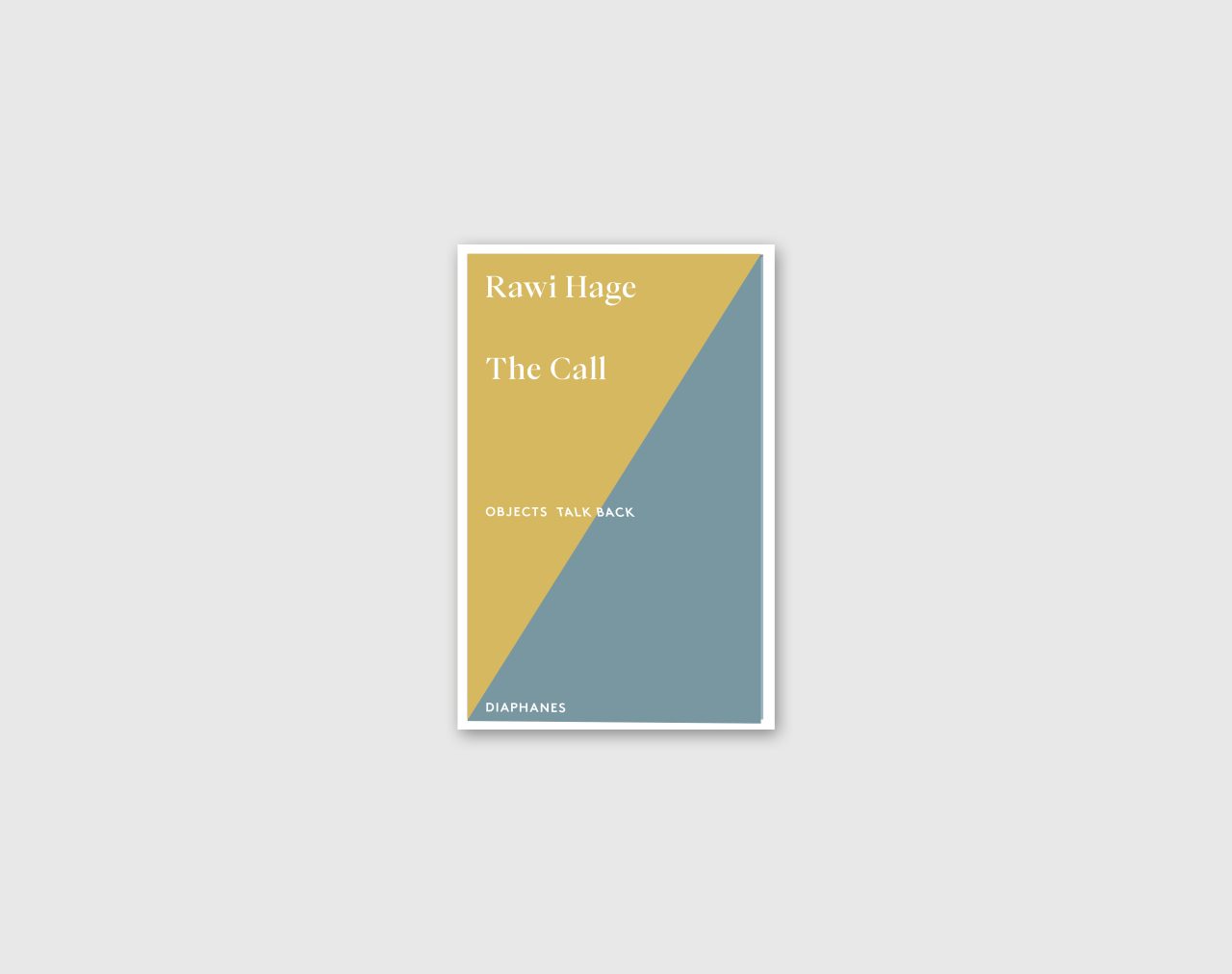
Rawi Hage: The Call
{{ time.start_TS | TS2dateFormat('MMM') }}
{{ time.start_TS | TS2dateFormat('YYYY') }}
| 8 € |
| Available in the Humboldt Forum shop and online |
| English, German |
| Part of: Objects talk back |
Following one of the Turfan archaeological expeditions in the early 1900s, a fragment of a Manichaean text written in Uyghur and Old Turkic found its way to the Museum für Asiatische Kunst of the Staatliche Museen zu Berlin. Originating from the Northern Silk Road region (now the Xinjiang Uyghur Autonomous Region in China), these ‘fragmented leaves’ became a source of inspiration for Rawi Hage: ‘I was born near Byblos in Lebanon. The ancient city of Byblos is believed to be the place where the first alphabet was invented.’ Encountering this rare and precious manuscript, with its layered and multicolored words, Hage reflects on the movement, uprooting, displacement, and migration of both objects and people.
Published by Stiftung Humboldt Forum im Berliner Schloss
Diaphanes, Paperback, 48 pages, 11 x 17 cm, ISBN 978-3-0358-0795-0
The double folio belongs to a rare collection of Manichaean fragments discovered in “Ruin K” at Kocho, once an important city in the eastern Tarim Basin. The excavations took place at the beginning of the 20th century as part of the German Turfan expeditions, during which numerous artworks and manuscripts were collected in Kocho and Bezeklik and other sites in the Turfan region and then taken to Berlin.
The manuscript fragments are held in the Museum für Asiatische Kunst and in the Berlin-Brandenburg Academy of Sciences, and for over one hundred years they have served as a major basis for research. The double-folio fragment contains texts in several languages and scripts, written in black and red ink. It vividly illustrates the cultural and linguistic diversity of the region.
Rawi Hage was born in Beirut and survived the Lebanese civil war of the 1970s and 1980s. He emigrated to New York and later moved to Montreal, where, as a photographer and writer, he explores themes of rootlessness, exile, and consequences of war. His novels have received internationally acclaimed literary awards and have been translated into thirty languages.