My body, my archive
{{ time.start_TS | TS2dateFormat('MMM') }}
{{ time.start_TS | TS2dateFormat('YYYY') }}
| Admission: 20 EUR / reduced 10 EUR |
| Ticket: Please book your ticket in advance online or at the box office in the Foyer |
| Info: Artist Talk with Faustin Linyekula on Dec 6 at 9:45 pm at the Foyer hosted by Kerstin Ortmeier |
| Info: No late entry ! |
| Suitable for: 12 years and older |
| Which languages: English |
| Accessibility: For the hearing-impaired |
| Venue: Ground Floor, Hall 2 |
| Belongs to: Transkontinentale 2025 |
GERMAN PREMIERE
Our movements, our breath, and our voices carry the elusive and mysterious traces of our origins.
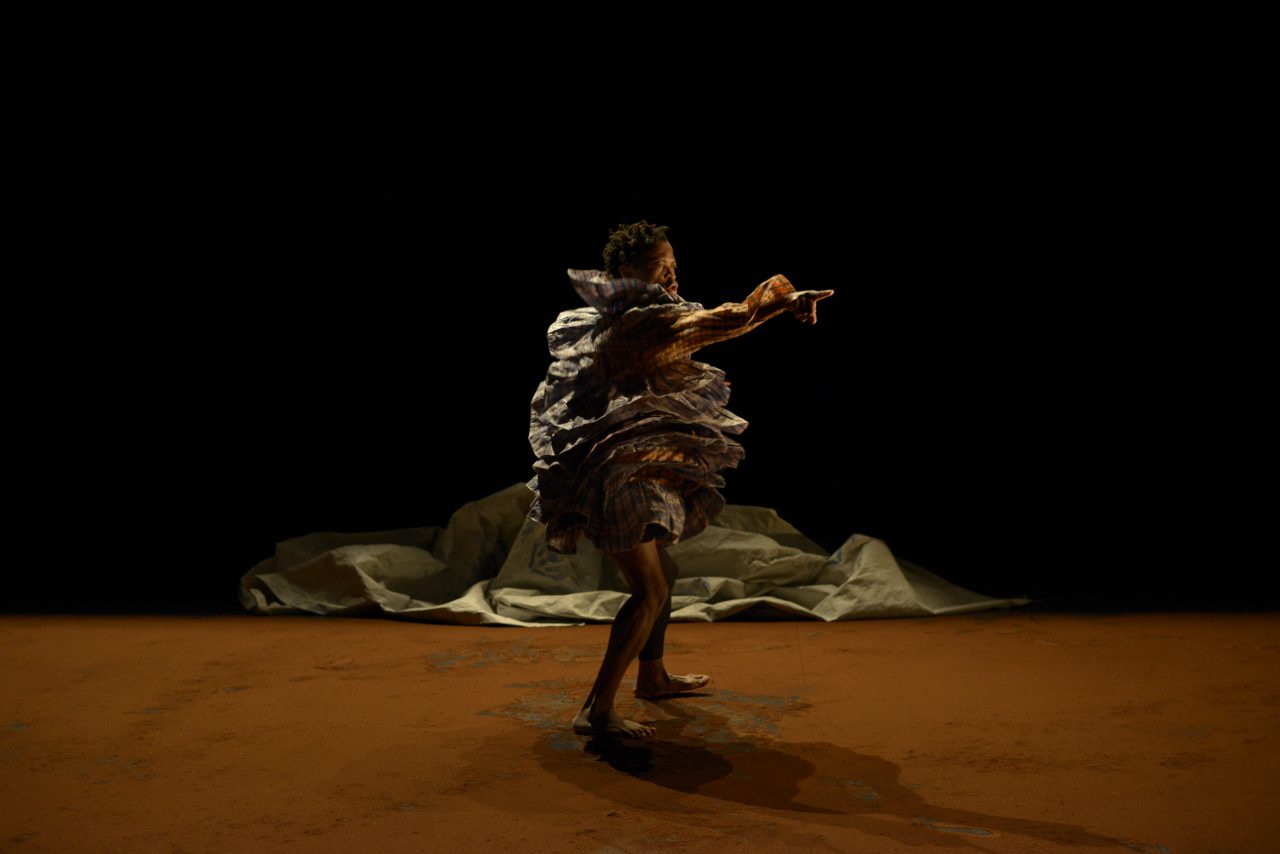
In his work My body, my archive, Congolese choreographer and dancer Faustin Linyekula delves deep into his own body, which serves as a tangible archive of his country and his ancestors.
With Banataba (2018), Linyekula created a ritual for his ancestors and took over the Royal Museum for Central Africa in Tervuren, which was undergoing renovation at the time, as part of the Kunstenfestivaldesarts (Brussels). Now he continues his search for a family archive destroyed by history, fragments of which are scattered between his body and the Congo. For this performance, he embarks on a journey through his own artistic work and family history, focusing on what was often missing from his family’s genealogy: the stories of the women. He pays tribute to them and commemorates them with a series of wooden statues commissioned from Gbaga, a sculptor from Lengola.
He is accompanied by Heru Shabaka-Ra from the Sun Ra Arkestra on trumpet.
In this moving dialogue, maternal ancestors recount the past in the land of the Lengola (a people and their language in the Democratic Republic of Congo) while Faustin Linyekula dances their presence in his present life.
“It has now been over 20 years since I began bringing my stories to the stages of the world. Today, I feel the need to pause and revisit this archive of personal creations, to question it. What parts of my body did I bring to each of these pieces? And above all: what traces have these pieces left on my body and my gestures?” (Faustin Linyekula)
Participants
Choreography and Dance: Faustin Linyekula
Trumpet: Heru Shabaka-Ra
Sculptures: Gbaga
Sound design and video: Franck Moka
Costumes design: Aldina Jesus
Dramaturgy: in dialogue with Eric Vautrin
Dramaturgy assistant: Dorcas Mulamba
Lighting design in collaboration with: Christophe Glanzmann
Additional music: Jamos (percussions), Passero (percussions), Mobeti (percussions), Joachim Montessuis (Nierica)
Production: Studios Kabako / Isaac Yenga
Coproduction: Chaillot – Théâtre National de la danse, Théâtre Vidy-Lausanne
With support from: Arts and Humanities Division, New York University Abu Dhabi
Special thanks to Catherine Wood and the Tate Modern, Londres
Dancer and choreographer Faustin Linyekula was born in Ubundu, Zaire (now the Democratic Republic of Congo) and lives and works in Kisangani in the northeast of the Democratic Republic of Congo. After studying theater and literature in Kisangani, he moved to Nairobi in 1993 and, together with Opiyo Okach, founded the Gàara Company in 1997, Kenya’s first contemporary dance group. In June 2001, back in Congo, he created Studios Kabako in Kinshasa, a space for dance and visual theater that offers training programs and supports research and productions. In his work, Faustin Linyekula deals with the consequences of decades of war, terror, fear, and economic collapse for himself, his family, and friends. Faustin Linyekula teaches regularly in Africa, Europe, and the United States. He has created numerous pieces for Studios Kabako, including more more … future (2009), Pour en finir avec Bérénice (2010), Le Cargo (2011), Stronghold (2012), Drums and Digging (2013), Statue of Loss (2014), The Dialogue Series: IV. Moya (2014), Banataba (2017), Not Another Diva (2018), Congo (2019) – the latter also shown at Hebbel am Ufer in Berlin.