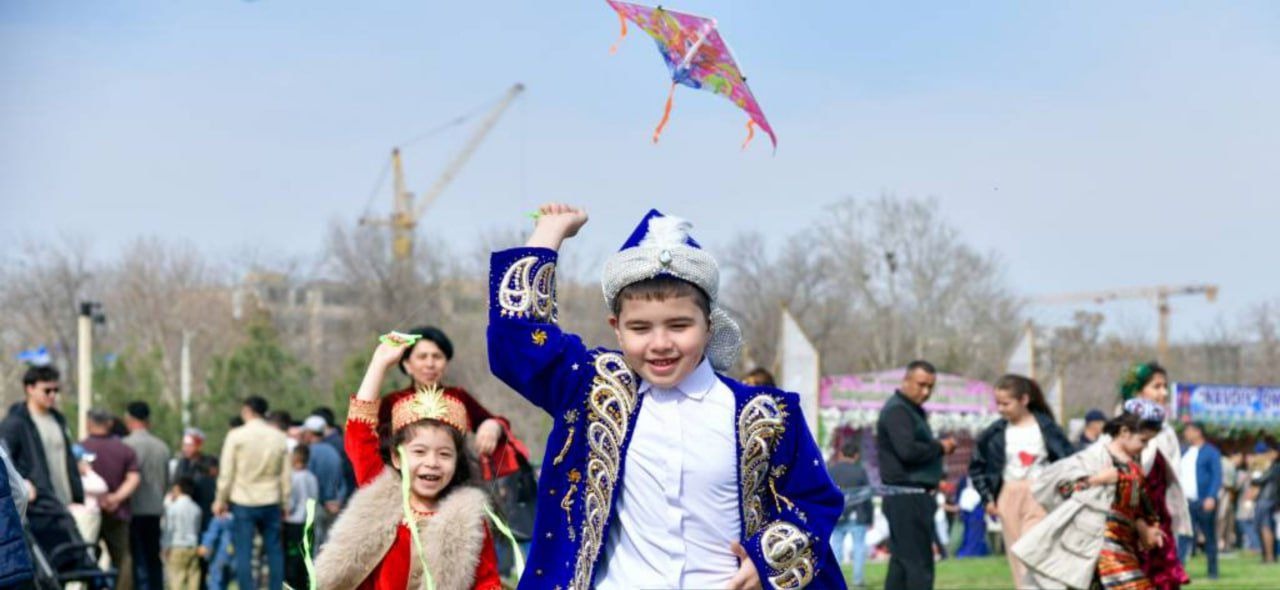
Flying kites, braided hair, painted eggs, and more
{{ time.start_TS | TS2dateFormat('MMM') }}
{{ time.start_TS | TS2dateFormat('YYYY') }}
| free admission |
| 2 years and older |
| German, Farsi, Kurmanji |
| Foyer, Ground Floor |
| Belongs to: Nouruz, Newroz, Nauroz |
The Spring Festival invites children, families and anyone else who is curious to learn about traditions from different regions through a varied programme of hands-on activities. In workshops and open events, visitors can make traditional Afghan and Uzbek kites and fly them together – a symbol of hope, new beginnings and shared joy.
Other activities focus on spring customs and cultural practices from the regions: stories and meanings behind the practice of braiding traditional Uzbek and Kurdish braids are shared. Have your hands painted with henna in the Iranian, Afghan or Kurdish tradition and discover different motifs and their meanings.
There are also creative stations for egg painting, flower wreath weaving and colouring and designing Haft Sin motifs.
In Afghan culture, the kite is a symbol of freedom, hope and communal joy. Kite flying has a long tradition, especially during the Nowruz festival, and brings people of different generations together.
Together we will build traditional Afghan kites and then fly them together in the sky.
The workshop will be led by Bashir Ahmad Tahmas, Mohammad Karim Asir and Ahmad Samim Farahmand. They are artists and cultural activists with extensive knowledge of Afghanistan’s traditional and folk customs and have experience in participatory, intercultural and artistic activities in public spaces.
Varrak – Freude und Hoffnung im Wind – Usbekische Drachen
In Uzbekistan, kite flying in spring is one of the lively traditions surrounding Navro’z that is still practised today. When nature awakens and the days grow longer, children, young people and adults go outdoors together to fly their homemade kites.
The Varrak is not just a toy, but an integral part of spring culture and a symbol of new beginnings. It embodies the transition from winter to spring, hope and personal wishes, as well as lightness and new beginnings. Especially at Navro’z, kite flying becomes a cross-generational ritual: children make their kites themselves or together with their parents and grandparents. Regardless of age or social background, this creates a communal moment that connects people and celebrates the awakening of nature. To this day, kite flying is also considered a symbolic expression of Navro’z itself – a visible sign of renewal, cohesion and confidence. Especially in times of social or personal challenges, it becomes an expression of resilience and creates space for hope, exchange and positive visions of the future.
For the Navro’z festival, San’at – Forum for Art, Culture and Science e.V. is presenting an intercultural family workshop on the design of traditional Uzbek kites.
The braiding of many fine braids has a long history in Uzbekistan and stands for beauty, femininity and cultural identity. The number 40 is considered a symbol of protection, wholeness and blessing – ‘40 braids’ therefore signify vitality and harmony.
Braiding is a cross-generational ritual in which mothers, grandmothers and daughters cultivate knowledge and community. Artistic hairstyles are created using natural care products and decorative ‘Jamalak’ braiding ribbons.
Experience this tradition up close: authentic braids, original jewellery and cultural exchange – especially during the spring festival of Navro’z, when braided hair symbolises renewal and joy of life.
In Kurdish tradition, braids symbolise a connection to the land and one’s roots. Cutting them off voluntarily can express grief or anger, while forced cutting is considered a violation of female identity and fertility and is understood as a form of humiliation. In the context of female fighters and women, braids also represent resistance and dignity.
The political dimension of Kurdish braids was widely discussed this year when a video of a cut braid appeared on social media. As a sign of solidarity and resistance, Kurdish women around the world braided their hair and shared it on social media.
Have yourself painted with henna according to Iranian, Afghan or Kurdish tradition and learn about different motifs and their meanings. Some of the associations participating in the festival will show which symbols and drawings are traditionally used in their communities and explain their cultural backgrounds.
One of these centuries-old traditional body arts, which was widespread in various communities in the Middle East, including among Kurds and Arabs, is called Deq. Women in particular practised and wore Deq symbols, which were used on certain occasions, such as life transitions, marriage or motherhood, as well as a sign of belonging or as a symbol of protection and healing.
The time around Newroz was traditionally considered a period of new beginnings and renewal. In this context, Deq symbols were often engraved in spring to symbolise protection, fertility and a good start to a new phase of life. Eylem Bozkaya explains selected symbols and demonstrates their practical application.
Painting eggs is a tradition in many cultures. On this day, visitors of all ages can decorate eggs artistically. Sanat – Forum für Kunst, Kultur und Wissenschaft e.V. also invites visitors to join in weaving flower wreaths. Meehr e.V. explains the various symbols of the Haft Sin tradition and invites visitors to learn about them through colouring and creative design.