Nowruz between pain and hope
{{ time.start_TS | TS2dateFormat('MMM') }}
{{ time.start_TS | TS2dateFormat('YYYY') }}
| free admission |
| Duration: 45 min |
| 12 years and older |
| German |
| Mechanical Arena in the Foyer |
| Belongs to: Nouruz, Newroz, Nauroz |
Nowruz has been celebrated for 3,000 years, and not all of those times have been peaceful. Even now, many people in Iran are mourning the loss of family members or friends who have been killed.
The Nowruz festival has often been banned, and it remains banned under the Taliban regime in Afghanistan.
But how do people deal with the festival during such painful times? How do you celebrate a festival when you don’t feel like celebrating, or when celebrating is criminalized?
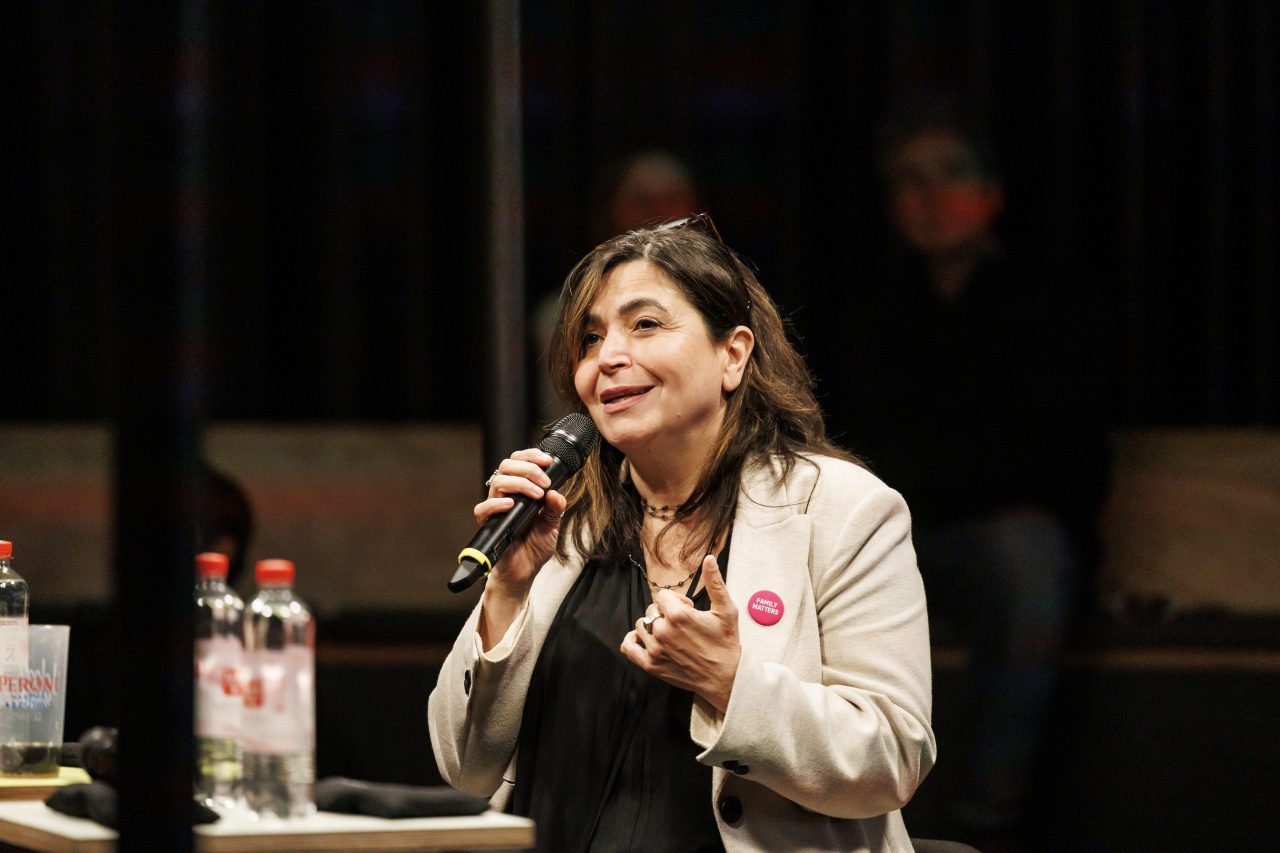
Mandana Syfeddinipur and Baura Haqiqat discuss this. The conversation is moderated by Azita Sharafkandi.
Participants
Dr. Mandana Syfeddinipur studied linguistics, among other subjects, in Berlin and earned her doctorate in Nijmegen. She heads the SOAS World Languages Institute in London and conducts research on the psychology and gestures of language.
Baura Haqiqat was born in Afghanistan and grew up in Germany. After graduating from high school, she studied to become a teacher, specializing in English, history, and religion, and completed her studies with the state examination. From an early stage, she combined her academic career with social activism.
During her studies, she worked as an author for Afghanistik Verlag and, in collaboration with the publisher, developed around ten language textbooks in Pashto and German for Afghan refugees. These books helped Pashto-speaking people learn German and settle into life in Germany. Thanks to this work, Pashto language books were included in German libraries for the first time, and a separate section for Pashto-language literature was created.
Since 2016, Baura Haqiqat has also worked as an interpreter for the Federal Office for Migration and Refugees, where she facilitates communication between government agencies and people with a migration background.
In addition to her linguistic and educational work, she is also an entrepreneur and has run her own security company in Germany for over ten years.
A particular focus of her work is promoting Afghan culture in Europe. Since 2017, she has been organizing Afghan concerts and cultural events in Germany, the Netherlands, and England, thereby creating spaces for the Afghan diaspora to come together. Among other things, she has organized performances by renowned artists such as Haider Salim, Najim Nawabi, Naghma, Salma Jahani, and Habib Qaderi.
Through her multifaceted work, Baura Haqiqat combines education, language, entrepreneurship, and culture to build bridges between cultures and raise the profile of Afghan culture outside her country of origin.
Azita Sharafkandi was born in Mahabad, East Kurdistan (Iran). Her work combines digital innovation, social engagement, and cultural expression. As an e-commerce and social media specialist with experience in artificial intelligence, she advocates for new technologies to better incorporate the perspectives of people with a migration background.
For over ten years, she has been advocating for human rights, democracy, and social participation. Her particular focus is on strengthening the Kurdish diaspora as well as promoting dialogue, diversity, and democratic values in Germany.
Azita Sharafkandi is a board member of the Kurdish Community in Germany (KGD) and the Kurdish Youth in Germany (KJD). There, she advocates for political education, cultural visibility, and the participation of Kurdish communities, particularly young people.
Another focus of her work is her commitment to feminism and women’s rights. From 2019 to 2022, she led a women’s group at the Federal Working Group of Immigrant Associations in Germany (BAGIV) in Berlin and organized political education and exchange programs for women.
In addition to her political activism, she is also culturally active: she hosts Kurdish events and is a singer who interprets Kurdish music in a modern style. For her, art is a form of remembrance, resistance, and cultural self-assertion.