Revolution Power Democracy
{{ time.start_TS | TS2dateFormat('MMM') }}
{{ time.start_TS | TS2dateFormat('YYYY') }}
| free of charge |
| German |
| Mechanical Arena in the Foyer |
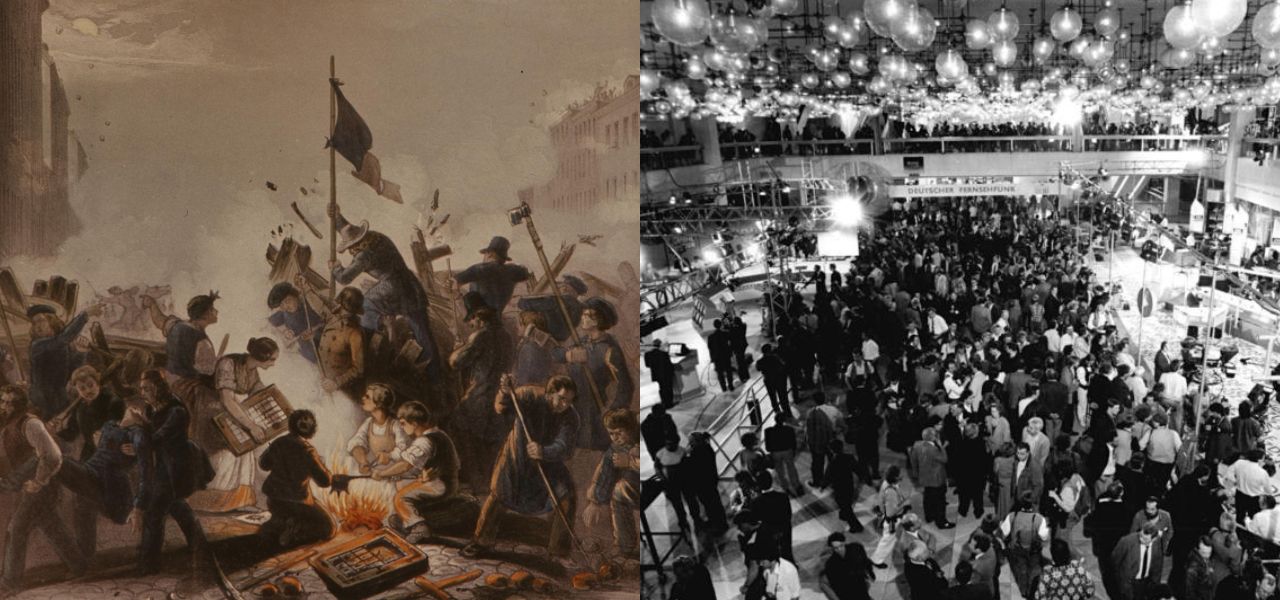
Democracy History Day in March 2026 will focus on two dates that are closely linked to the history of the place: March 18, 1848, with the “March Revolution,” and March 18, 1990, with the first free People’s Chamber election in the GDR. In both moments, political engagement suddenly became visible and effective. Whether protests in the Tiergarten, reading cafés, and “cat music” in 1848 or round tables, Monday demonstrations, and new participation forums in 1989/90. The panel will discuss how protest became political practice. And what we can learn from these historical upheavals for our democracy today.
Conversation with
Dr. Claudia Gatzka, Research Associate for Modern and Contemporary History of Western Europe, Albert Ludwig University of Freiburg, Co-Chair of the Board of Trustees of forum 1848 at the Cemetery of the March Fallen
and
Prof. Dr. Paul Nolte, Professor of Modern History and Contemporary History, Free University of Berlin
Moderated by Dr. Hanno Hochmuth, Research Associate and Project Manager at the Leibniz Lab “Social Upheavals and Transformations,” Leibniz Center for Contemporary History Research Potsdam
Welcome by Dr. Judith Prokasky, Stiftung Humboldt Forum im Berliner Schloss
An event marking the nationwide Day of Democracy History.
An event organized by:
forum 1848 at the Cemetery of the March Fallen, Leibniz Center for Contemporary History Research Potsdam (ZZF), and Stiftung Humboldt Forum im Berliner Schloss
The event will be preceded by a city tour with Paul Schmitz (forum 1848) on the topic. Meeting point at 3:45 p.m. at the World Clock on Alexanderplatz, ending at 4:45 p.m. at the Humboldt Forum.
You can register here (the event is free of charge).