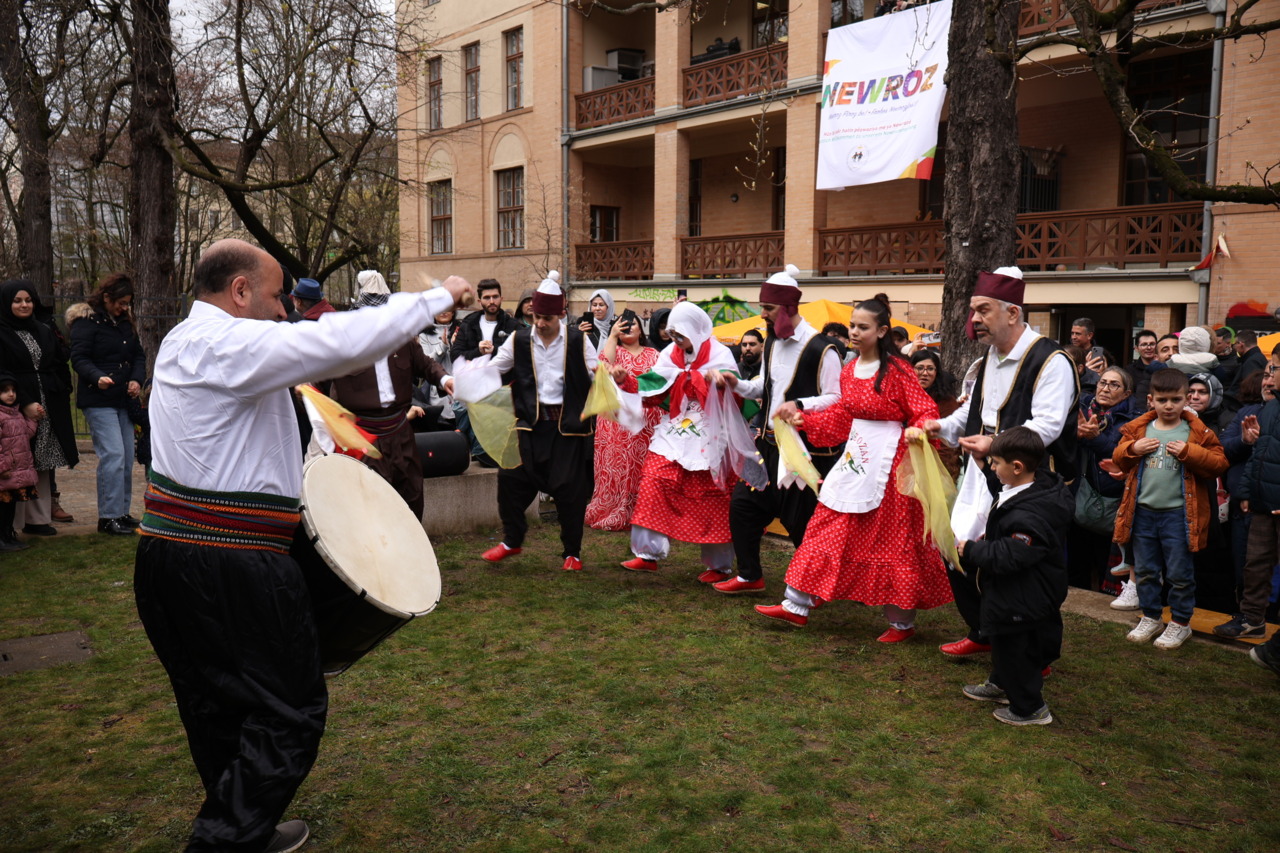
The significance of the Newroz festival for Kurdish families
{{ time.start_TS | TS2dateFormat('MMM') }}
{{ time.start_TS | TS2dateFormat('YYYY') }}
| free admission |
| Mechanical Arena in the Foyer |
| Belongs to: Nouruz, Newroz, Nauroz |
The history of Newroz is closely linked to Kurdish identity. What significance does Newroz have for Kurdish families? How is Newroz celebrated today in all four geographical parts of Kurdistan? What does Newroz mean for Kurdish families in Germany?
Peshraw Mohammed, Rojda Arslan and Matthias Hofmann will discuss these questions.
Azita Sharafkandi will moderate the discusssion.
Participants
Azita Sharafkandi was born in Mahabad, East Kurdistan (Iran). Her work combines digital innovation, social engagement, and cultural expression. As an e-commerce and social media specialist with experience in artificial intelligence, she advocates for new technologies to better incorporate the perspectives of people with a migration background.
For over ten years, she has been advocating for human rights, democracy, and social participation. Her particular focus is on strengthening the Kurdish diaspora as well as promoting dialogue, diversity, and democratic values in Germany.
Azita Sharafkandi is a board member of the Kurdish Community in Germany (KGD) and the Kurdish Youth in Germany (KJD). There, she advocates for political education, cultural visibility, and the participation of Kurdish communities, particularly young people.
Another focus of her work is her commitment to feminism and women’s rights. From 2019 to 2022, she led a women’s group at the Federal Working Group of Immigrant Associations in Germany (BAGIV) in Berlin and organized political education and exchange programs for women.
In addition to her political activism, she is also culturally active: she hosts Kurdish events and is a singer who interprets Kurdish music in a modern style. For her, art is a form of remembrance, resistance, and cultural self-assertion.
Peshraw Mohammed, from South Kurdistan, lives in Berlin. He is a freelance author and translator in the fields of German philosophy, cultural history of National Socialism, anti-Semitism and anti-Kurdism, with a focus on the geopolitics of the Middle East. He is the author of numerous books and essays in Kurdish, German and English.
Rojda Arslan is a lawyer specialising in international law and human rights. She is the managing director of Roj Empowerment, co-head of the anti-discrimination department at Yekmal e.V. and an anti-racism trainer.
Matthias Hofmann (Dipl. Päd.) has published works on Kurdish history and is the founder of tîr-verlag, a publishing house that publishes books on Kurdish topics. He is head of the primary school department and co-director of the anti-discrimination department at Yekmal e.V..