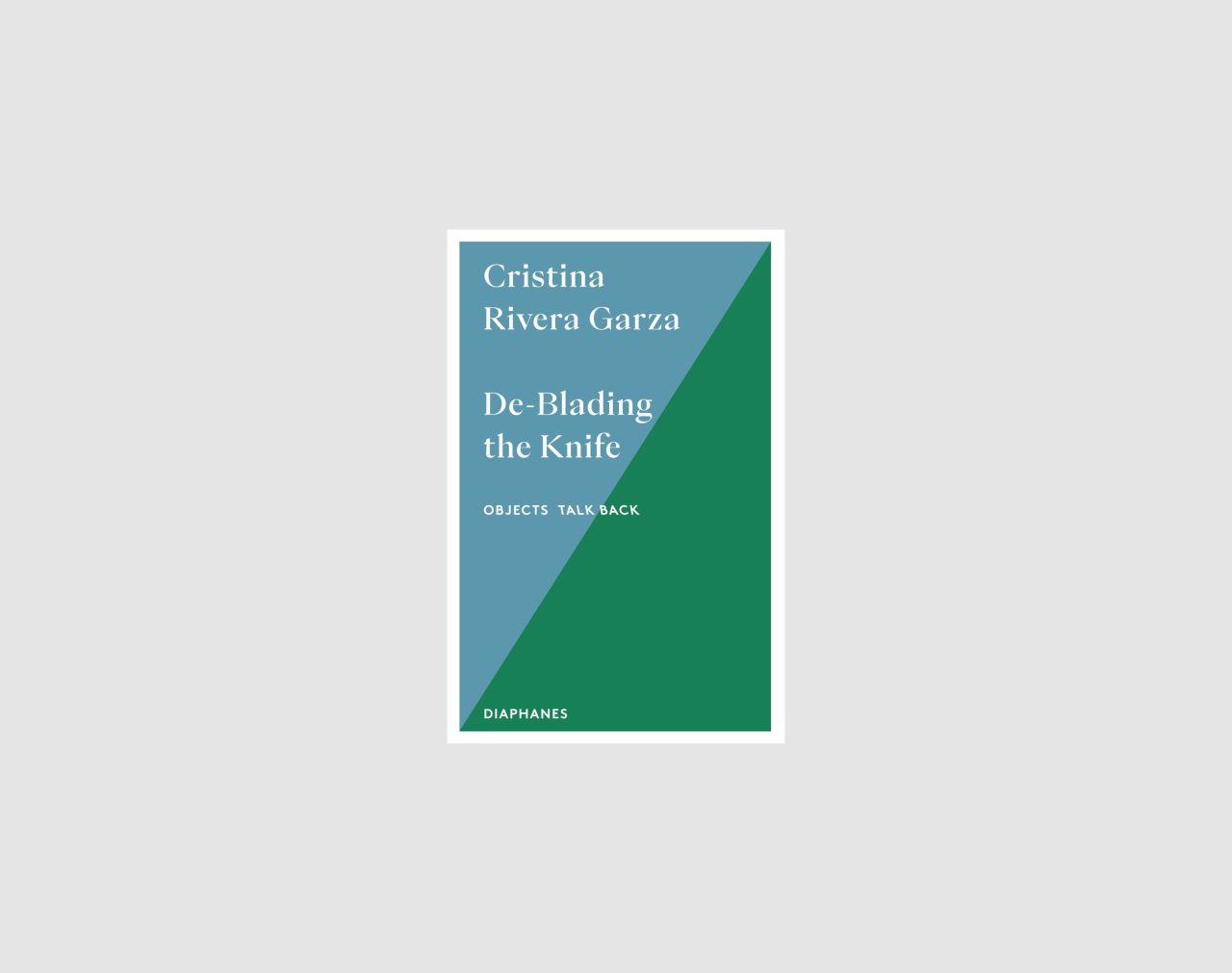
Cristina Rivera Gaza: De-Blading the Knife
{{ time.start_TS | TS2dateFormat('MMM') }}
{{ time.start_TS | TS2dateFormat('YYYY') }}
| Admission: 10 € |
| Info: Now available at the Humboldt Forum shop and online |
| Which languages: English, German |
| Part of: Objects talk back |
Inspired by a walrus-ivory storyknife from Alaska, Mexican writer Cristina Rivera Garza creates a multi-faceted narration that asks: what is remembered? How? For whom? The ephemeral strokes of a Story Knife were traditionally drawn by young Yup´ik girls into soil or snow to repeat old tales that would then fade away. Rivera Garza connects this empowering ancient Indigenous practice to the Violentómetro, a contemporary tool designed in Mexico to measure instances of intimate partner violence. The story of violence against women constantly disappears even as it is continuously told, re-told. Might a Story Knife play a role in reversing such erasure?
Published by Stiftung Humboldt Forum im Berliner Schloss
68 pages, Paperback, Diaphanes Verlag, ISBN 978-3-0358-0909-1
Snow knives or yaaruin, such as this one, were among the objects collected by Johan Adrian Jacobsen (1853–1947). He was a Norwegian sailor who undertook numerous expeditions on behalf of European museums. For what was then called the Royal Museum of Ethnology in Berlin, now the Ethnologisches Museum Berlin, he traveled, among other places, to Alaska and the northwest coast of North America. His collecting activities took place within the context of 19th-century colonial ethnology and were also connected to so-called ethnographic exhibitions, or “human zoos”.
The knives, mostly carved from wood, bone, or walrus tusk, were used by the Yup’ik of southwestern Alaska to draw stories in the snow or into the ground. Through lines and forms, narrated scenes were brought to life. The snow knives thus served as an important medium of oral tradition and the cultural transmission of knowledge.
Cristina Rivera Garza was born in Matamoros, Mexico. She is a writer, translator, critic. Recent publications include Liliana’s Invincible Summer, Pulitzer Prize Memoir 2024. She is Hugh Rot and Lillie Cranz Cullen Distinguished Chair and founder of the PhD Program in Creative Writing in Spanish at the University of Houston, Department of Hispanic Studies.