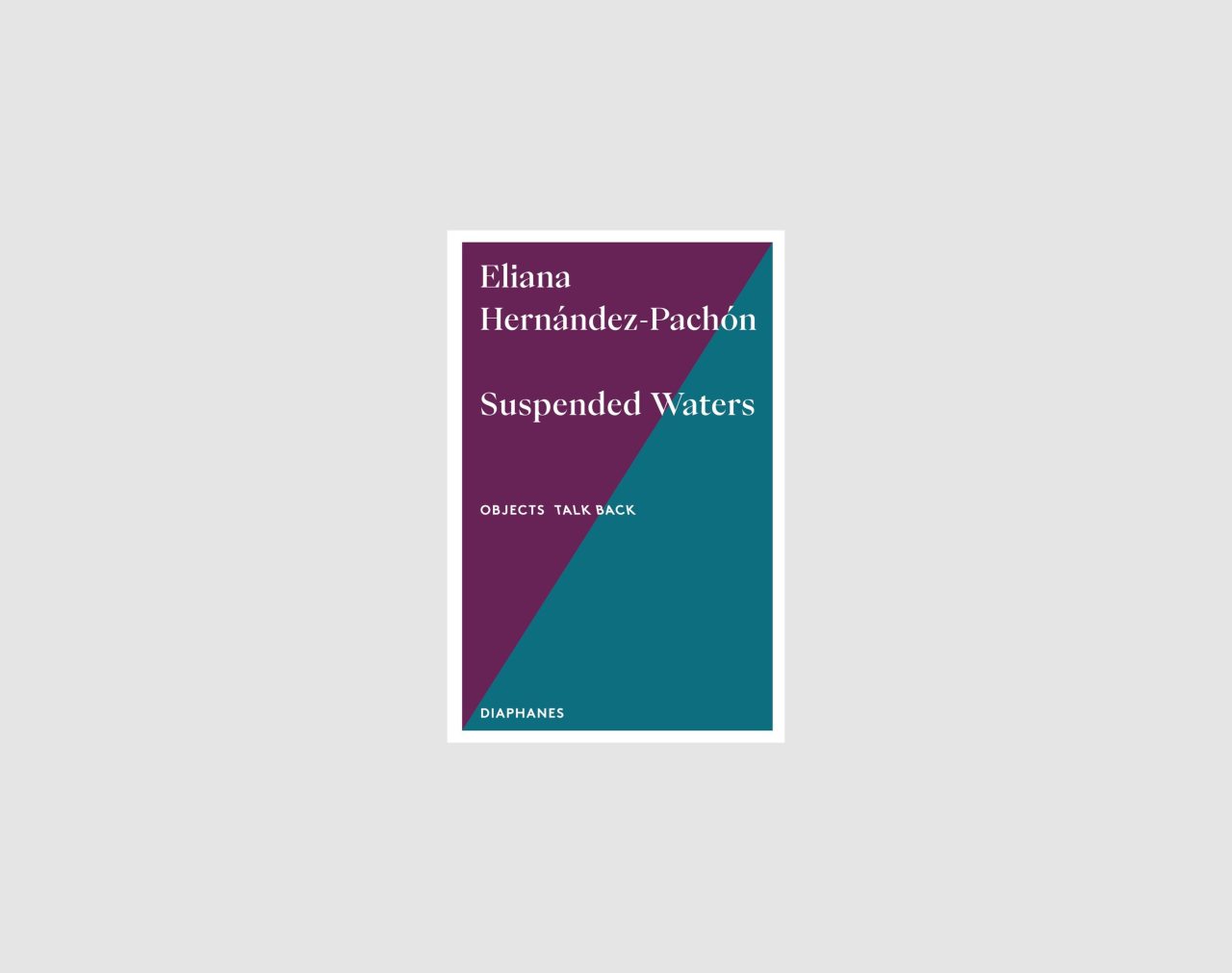
Eliana Hernández-Pachón: Suspended Waters
{{ time.start_TS | TS2dateFormat('MMM') }}
{{ time.start_TS | TS2dateFormat('YYYY') }}
| Admission: 10€ |
| Info: Now available at the Humboldt Forum shop and online |
| Which languages: English, German |
| Part of: Objects talk back |
Suspended Waters is a poetic essay that connects four objects: a death raft woven from reeds that has come ashore in the wrong place, a gold Muisca raft that evokes the legend of “El Dorado”, Amazonian flutes made of palm that can only be seen by men and a sheet of paper used for museum records.
Colombian writer Eliana Hernández-Pachón explores how these objects sustain different worlds. Through a text pulsing with the life of more-than-human beings, with multiple voices solo and choral, Hernández-Pachón evokes worlds of ritual, sanctity, abundance. She asks: what does it mean to possess, to preserve, to let go?
Yuruparí flutes
The so-called Yuruparí flutes came to what was then called the Royal Museum of Ethnology in Berlin, now the Ethnologisches Museum Berlin, at the end of the nineteenth century through Franz Pfaff and at the beginning of the twentieth century through Theodor Koch-Grünberg. While very little is known about Pfaff, considerably more is known about Koch-Grünberg, who, as an anthropologist and explorer, wrote his own accounts of his expeditions to South America and thoroughly documented his collection.
Each flute’s interior consists of a piece of paxiúba palm. Because their music plays an important role in male initiation rituals, the flutes remain concealed from women. For this reason, they are currently neither displayed in exhibitions nor shown in illustrations. One story about the Yuruparí flutes that continues to be told to this day recounts how they were once stolen by women and then recaptured.
Published by Stiftung Humboldt Forum im Berliner Schloss
56 pages, Paperback, Diaphanes Verlag, ISBN 978-3-0358-0910-7
Eliana Hernández-Pachón was born in Bogotá, Colombia. Her first book, The Brush, is an aching work of historical reckoning. She commemorates the massacre in the village of El Salado in 2000 and the wider tragedy of mass murders in Colombia. The Brush received Colombia’s National Poetry Prize in 2020, making Hernández-Pachón the youngest poet to ever receive this honor. She is part of Como un lugar, a poetry collective that runs an independent press in Buenos Aires and organizes literary festivals in New York City and Latin America. She lives in Brooklyn, New York.