Auf den Spuren von Shiva
{{ time.start_TS | TS2dateFormat('MMM') }}
{{ time.start_TS | TS2dateFormat('YYYY') }}
| Admission: Freier Einritt |
| Which languages: English, German |
| Venue: Ground Floor, Hall 2 |
| Belongs to: Opening Mine. Yours. Ours!?, Tracing Shiva. Between Berlin and Kathmandu |
How does the meaning of a sacred object change when it becomes part of a museum collection?
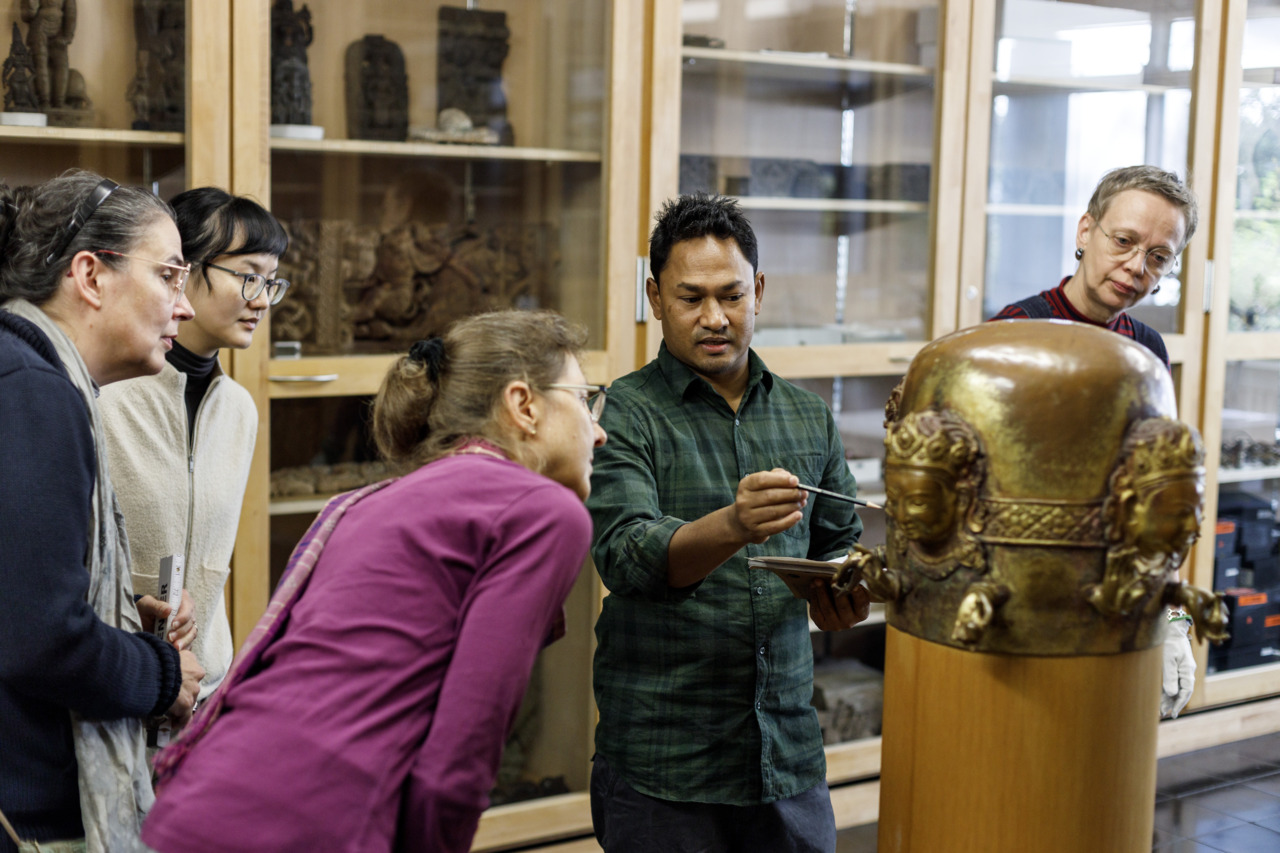
Visual anthropologist and filmmaker Deepak Tolange and the museum team offer insights into their joint research on a Shiva Linga kosh from Nepal, which is now part of the collection of the Museum of Asian Art. The conversation explores religious practices, the loss of cultural heritage, and the responsibility of museums in dealing with sacred objects.
Nhé’ẽ are circular conversations where knowledge, experiences, and perspectives are shared. The term comes from the Guarani language and can mean the word, the voice, and language, but also the spirit.
Saturday, 28 November 2026
with Deepak Tolange, Lilla Russell-Smith and Henriette Lavaulx-Vrécourt
Sunday, 29 November 2026
with Deepak Tolange, Sophia Bokop and Lilla Russell-Smith
Participants
Deepak Tolange is a filmmaker, photographer and researcher from Nepal who is interested in innovation, history, culture, the environment, and social justice. During his CoMuse Fellowship, Deepak investigated the history and provenance of the Shiva Linga – a sacred object from Nepal currently in the collection of the Museum für Asiatische Kunst – in close collaboration with the museum team. He also continued to work on his documentary film which highlights the deep connection and significance of sacred objects in contemporary Hindu communities for their very existence, life, and beliefs. The project seeks to raise public awareness regarding the loss of cultural belongings from Nepal.
Dr. Lilla Russell-Smith has been Curator of Central Asian Art at the Museum für Asiatische Kunst since 2007. Born in Budapest she studied History and Art History at the Lóránd Eötvös University (ELTE) in Budapest and Chinese Language and Art and Archaeology at the School of Oriental and African Studies (SOAS), University of London. She was co-editor of the Journal of Inner Asian Art and Archaeology (2006-2016). She coordinated the digitisation of the paintings from Dunhuang in the Stein Collection at the British Museum and catalogued the historical photo collection of Aurel Stein at the Hungarian Academy of Sciences in Budapest together with John Falconer (British Library) (vol. 1: 2002, vol. 2: 2007). Her book Uygur Patronage in Dunhuang: Regional Art Centres on the Northern Silk Road in the Tenth and Eleventh Centuries (Brill, 2005), was published recently in Chinese translation (2026). At the Museum für Asiatische Kunst she curated several exhibitions, including “Cultural Exchange on the Northern Silk Road” 01.04.2009-03.01; “The Eight Manifestations of the Precious Teacher – Padmasambhava in Art and Ritual in the Himalayas” 28.11.2013- 29.06.2014 accompanied by a catalogue (with Hans-Werner Klohe); “The Ruins of Kočo: Traces of Wooden Architecture from the Ancient Silk Road” 07.09.2016-08.01.2017 accompanied by a book (edited with Ines Konczak-Nagel). At the Humboldt Forum, she curates the modules “Arts from the Northern Silk Road” (Rooms 317 and Room 315) within the permanent exhibition of the Museum für Asiatische Kunst and “Himalaya” (Room 315) (with Henriette Lavaulx-Vrécourt), and the collaborative exhibition Tracing Shiva: Between Berlin and Kathmandu (opening November 2026)
Henriette Lavaulx-Vrécourt works as a curator for the East and North Asia Department at the Ethnological Museum, National Museums in Berlin – Prussian Cultural Heritage Foundation. She coordinates and participates in various collaborative research projects with colleagues from China, Japan, Korea, Nepal, Siberia, and Mongolia. At the Humboldt Forum, she has curated several exhibitions, such as the permanent exhibition Himalaya (since 2019), co-curated with her colleague Lilla Russell-Smith; the special exhibition Ancestors, Goddesses, and Heroes (2022–2023); and the collaborative exhibition In the Footsteps of Shiva: Between Berlin and Kathmandu (opening August 2026). She participates in events at the Dahlem Research Campus, where she designed two exhibition stations within the “Denkraum”: one on time and temporality, and another on literatures. She is a co-editor of the Baessler-Archiv, the scholarly journal of the Ethnological Museum. Her recent works include: Co-author of the guide Tracing Loot from the ‘Boxer War’ in China (2026); The Ainu Collection at the Ethnological Museum in Berlin, in: Ainu Collections at the Vienna World Exposition of 1873, National Ainu Museum, Hokkaido, pp. 72–75 (2025); Treasures of Mongolian Historical and Cultural Heritage in Germany (editor, 2024); and Berlin Battle Engravings – 34 Copperplates for the Emperors of China (editor, 2021).
Sophia Bokop is a provenance researcher in the project “The Collaborative Museum” at the Ethnologisches Museum and Museum für Asiatische Kunst. Together with international partners, she researches selected collections and their contexts of acquisition, appropriation and translocation as part of collaborative, transdisciplinary projects.