Artistic representation of cryovolcanism on Enceladus
© ESA/Science Office
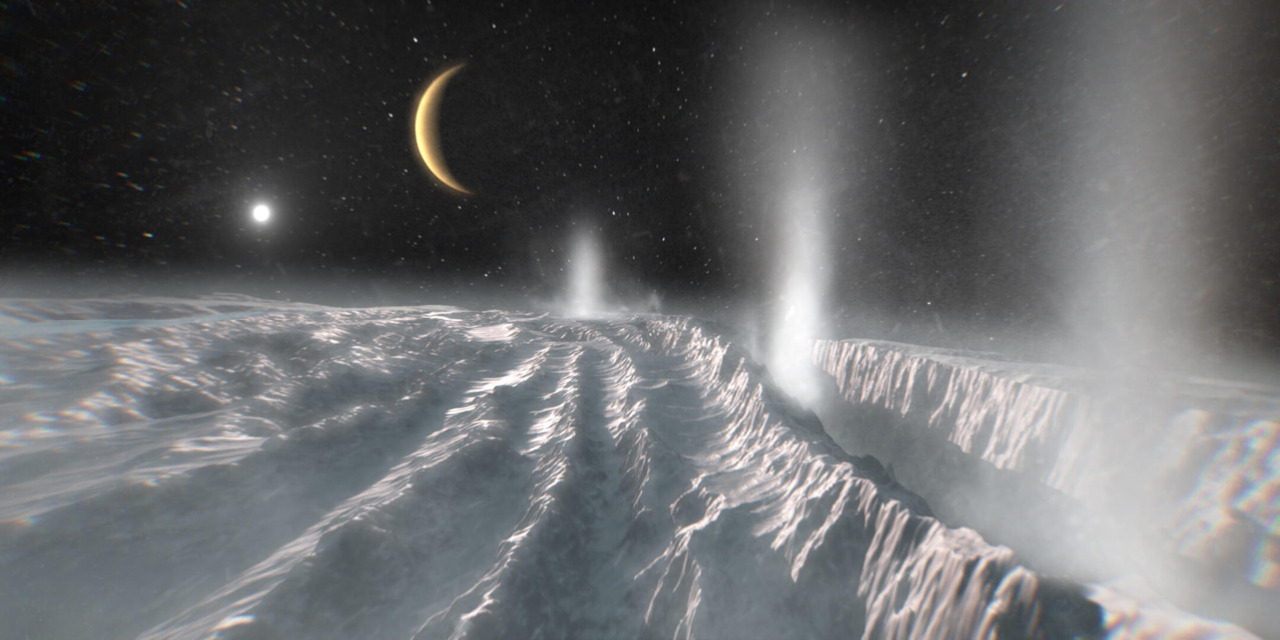
image 1:
Artistic representation of cryovolcanism on Enceladus
© ESA/Science Office
Science and Humanities, Talk, Workshop
Water in the Solar System
Meet the Scientist with Frank Postberg
Past events
{{ time.start_TS | TS2dateFormat('DD') }}
{{ time.start_TS | TS2dateFormat('MMM') }}
{{ time.start_TS | TS2dateFormat('YYYY') }}
{{ time.start_TS | TS2dateFormat('MMM') }}
{{ time.start_TS | TS2dateFormat('YYYY') }}
| Planning: Duration: 90 min |
| Which languages: German |
| Venue: Humboldt Lab, 1st floor |
| Part of: On Water |
From a scientific perspective, where are the most promising places to find extraterrestrial life? On which celestial bodies will space missions specifically search for extraterrestrial life in the near future? Frank Postberg takes us on a journey to the planets and moons of our solar system and their water reserves.
Frank Postberg
© Privat
Frank Postberg is a professor of planetary science at Freie Universität Berlin. His research focuses on habitable oceans in the outer solar system, and he is involved in several international space missions, including NASA’s Europa Clipper mission. Among his most notable discoveries is the detection of salt, organic compounds, and phosphates in the ocean of Saturn’s moon Enceladus.