An Island in the Making
{{ time.start_TS | TS2dateFormat('MMM') }}
{{ time.start_TS | TS2dateFormat('YYYY') }}
| 8 EUR / reduced 4 EUR |
| Duration: 120 min |
| Ground Floor, Hall 3 |
| Part of: SITE SPECIFICS |
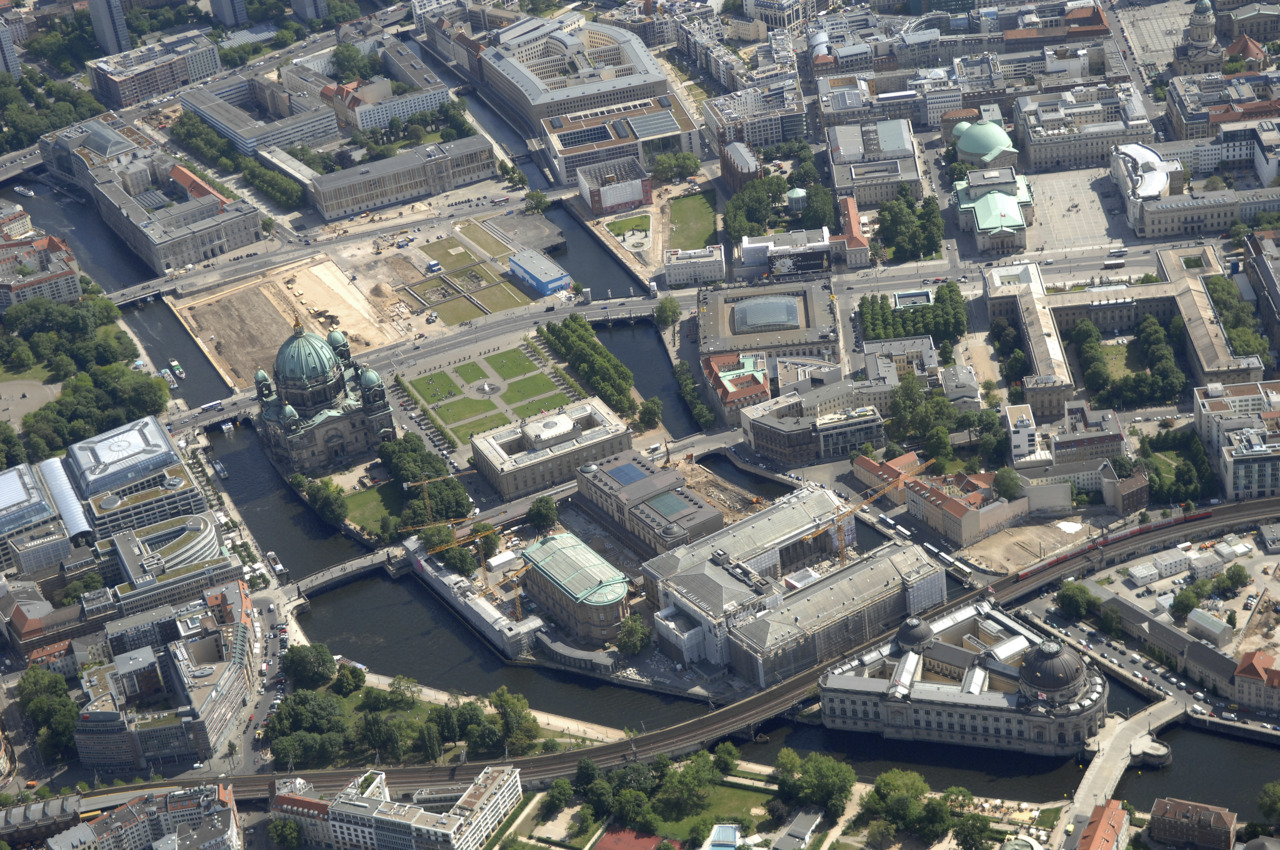
How do we, as an urban society, want to shape the heart of Berlin? What do we expect from the core of our city – and who should this place be for? Should the Spree Island primarily be a site of remembrance and representation, or should it offer space for a vibrant, diverse urban life? How can past, present, and future come together here?
These questions have been the subject of intense debate for decades. Twenty-five years ago, the International Expert Commission “Historische Stadtmitte Berlin” presented a widely discussed vision for the future of Berlin’s Spree Island. Although its recommendations were highly controversial, they have significantly shaped the development of this central site: the demolition of the Palace of the Republic and the reconstruction of the Berlin Palace as the Humboldt Forum have redefined Berlin’s city center.
On the occasion of the anniversary, the Humboldt Forum invites audiences to take a fresh look at the Spree Island. The focus is on the formative visions, conflicts, and hopes, as well as on current challenges. Finally, we ask about the future of the Spree Island and its surroundings, such as the Marx-Engels Forum and the site of the Bauakademie.
In a multifaceted dialogue, experts from urban development, architecture, politics, and civil society come together. On the panel, Franziska Eichstädt-Bohlig, former member of the International Expert Commission, Manfred Kühne, long‑standing head of the Department for Urban Development and Projects at Berlin’s Senate Department for Urban Development, Building and Housing, and Leslie Quitzow from the Bundesstiftung Bauakademie take part in the discussion. The architectural historian and publicist Matthias Grünzig introduces the topic and moderates the panel.
Participants
Franziska Eichstädt‑Bohlig is a graduate engineer in architecture and urban planning. Beginning in 1969, she worked as an architect and urban planner, including a senior position at the Berlin urban renewal agency STATTBAU. In 1989/90, she served as District Councillor for Building and Planning ( Baustadträtin) in Berlin‑Kreuzberg. As a member of the German Bundestag from 1994 to 2005, she worked on issues relating to construction, housing, and budgetary policy. From 2006 to 2011, she was a member of the Berlin House of Representatives, serving until 2009 as parliamentary group chair of Bündnis 90/Die Grünen (Germany’s Green Party). From 2000 to 2001, she was a member of the International Expert Commission “Historische Mitte Berlin” (Historic Center of Berlin). To this day, she remains actively involved in key debates and committees concerned with building culture, urban development, and memory culture.
Manfred Kühne studied architecture in Kaiserslautern and Berlin from 1978 to 1987 and passed his state examination in structural engineering in 1991. He then worked at the urban planning office urbanistica until 1994, and from 1994 to 1997 in the architecture workshop “Architekturwerkstadt” of Senate Building Director Hans Stimmann.
From 1997 to 2001, he headed the urban planning office in Stralsund. After that, he served as Head of the Supreme Heritage Conservation Authority in Berlin from 2001 to 2008, and from 2008 to 2024 as Head of the Department for Urban Development and Projects in the Senate Administration for Urban Development in Berlin.
He is also active as Chairman of the German Academy for Urban and Regional Planning Berlin-Brandenburg and participates in the Schinkel Committee of the Architects’ and Engineers’ Association of Berlin.
Dr. Leslie Quitzow has been serving as Transformation Manager for Urban Development and the Real Estate Sector at the Bundesstiftung Bauakademie since 2022. In this role, she led a neighborhood consortium in 2023 focused on the energy-efficient renovation of the “Schinkel Quarter” in Berlin’s historic city center.
Prior to this, she worked for many years as a science manager at the WZB Berlin Social Science Center as well as at various universities. There, she coordinated research consortia on topics including urban development, the energy transition, and international cooperation.
Leslie Quitzow holds a degree in architecture (Diplom-Ingenieurin) and earned a doctorate in social sciences.
Dr. Matthias Grünzig, born in 1969 in Berlin, is an architectural historian and publicist. He is the author of numerous publications on central Berlin, including “Der Fernsehturm und sein Freiraum – Geschichte und Gegenwart im Zentrum Berlins” (2022), and has curated several exhibitions, including exhibitions on 50 Years of the Berlin Television Tower and Karl‑Liebknecht‑Straße. Since 2015, he has been active in the Offene Mitte Berlin initiative. In 2021/22 he served as a citizens’ representative in the Molkenmarkt competition and workshop process and has been a member of the Scientific Advisory Board of the Hermann-Henselmann-Stiftung since 2022.