Mikeka
{{ time.start_TS | TS2dateFormat('MMM') }}
{{ time.start_TS | TS2dateFormat('YYYY') }}
| Mechanical Arena in the Foyer |
| Part of: Guestroom |
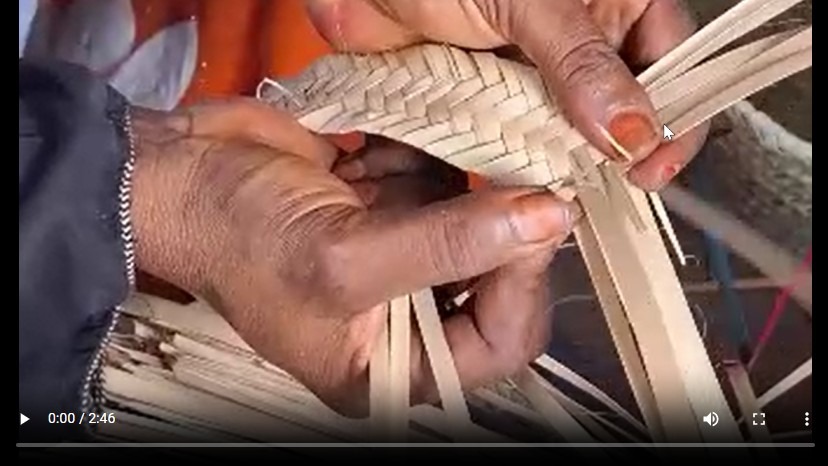
Mikeka is the Kiswahili word for a type of mat traditionally woven primarily by women. Recently, it has also become the title of an online archive, Mikeka, documenting the knowledge gained within the project Talking Mats: Interwoven Histories – Connecting People, which brings together the Lamu Museums in Kenya and the Ethnologisches Museum in Berlin. Inspired by the performative knowledge practices of Swahili culture, the project members in Berlin invite visitors to the Guestroom to collaboratively and actively contribute something in return for the mats the women of Kipini and Ozi (Kenya) have created in dialogue with and for the collaborating museums.
The Guestroom is structured in three parts. After a brief introduction, some project members from Berlin reflect, by referring to the online archive, on what they have learned through mikeka. These reflections aim to inspire participants for the following hands-on part of the evening. Attendees are invited to jot down spontaneous thoughts and to contribute them with their voices in poetic form. Additional opportunities for participation are offered in the centre of the guest room, where visitors can learn and practice the technique of plaiting mikeka together with members of the tubman.network.
Sophia Bokop is a social and cultural anthropologist and involved as a provenance researcher in the project The Collaborative Museum at the Ethnologisches Museum and Museum für Asiatische Kunst at the Staatliche Museen zu Berlin. Together with international partners, she researches selected collections and their contexts of acquisition, appropriation and translocation as part of collaborative, transdisciplinary projects.
Jasmin Mahazi is a Afro-German social and cultural anthropologist and independent researcher affiliated with the Leibniz-Zentrum Moderner Orient, Berlin. Her ongoing research focusses on oral and matrifocal knowledge practices along the Swahili Coast. She is engaged in multimodal ethnographic research projects.
Cristina Navarro is a curator for digital projects in the project “The Collaborative Museum” at the Ethnologisches Museum and Museum für Asiatische Kunst. She has extensive experience in digital mediation, both in exhibition spaces and online. Her focus lies in implementing digital access to museum collections through individual digital projects as well as through holistic digital strategies.
CoMuse – The Collaborative Museum is an initiative of the Ethnologisches Museum and the Museum of Asian Art that aims to develop multiperspective approaches to collection-based research and to test new formats for collaborative processes. Its goal is to sustainably intensify the decolonization and diversification of museum practices.